
TDX - Travel API Aggregation Hub

Enterprise Travel Connectivity at Scale
OTAs, consolidators, TMCs, and DMCs need to aggregate diverse supplier content while maintaining operational control, data quality, and integration flexibility.
Each supplier brings different schemas, interfaces, and operational requirements. Building and maintaining individual integrations for dozens of sources creates complexity, increases integration costs, and slows your ability to respond to market changes. Enterprise travel organizations need a unified aggregation and orchestration layer.
TravelCarma Travel Data Xchange (TDX): Enterprise Supplier Integration & Orchestration
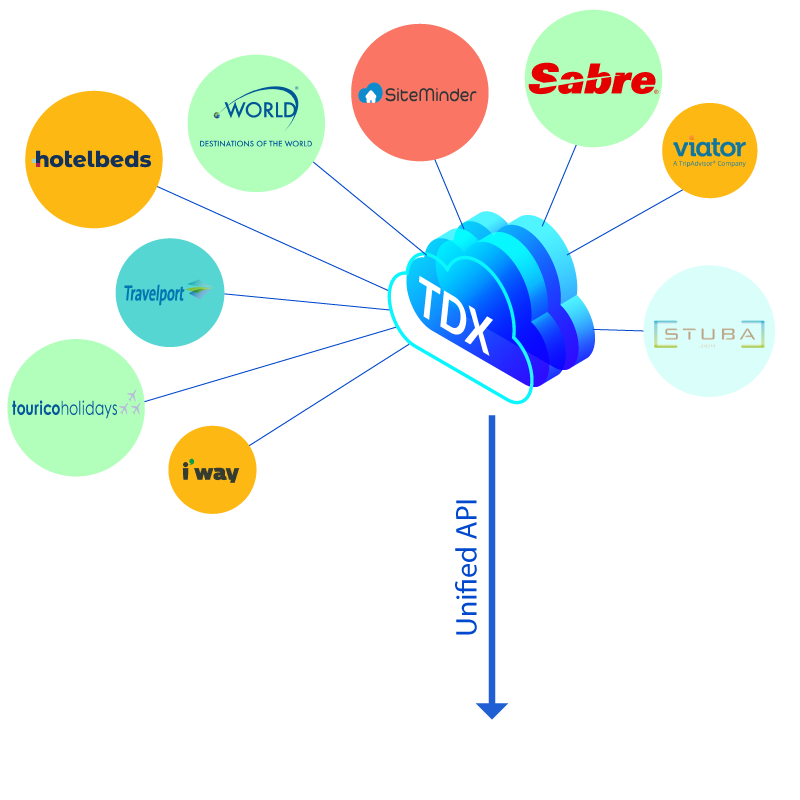
TDX is an enterprise-grade connectivity and orchestration platform that normalizes, aggregates, and routes content from multiple supplier sources—GDSs, consolidators, bedbanks, channel managers, and custom providers—through a single unified API and operational interface.
TDX enables your team to manage supplier relationships, control data quality, orchestrate real-time feeds, and integrate with your existing booking, distribution, and legacy systems without reimplementing core logic.
TDX connects to all major travel supplier ecosystems
GDSs (Global Distribution Systems)
LCCs
Consolidators
Bedbanks
Channel Managers
Car Rental and Transfers Providers
Bus Operators
Sightseeing and Excursions Providers
DMCs
Payment Gateways
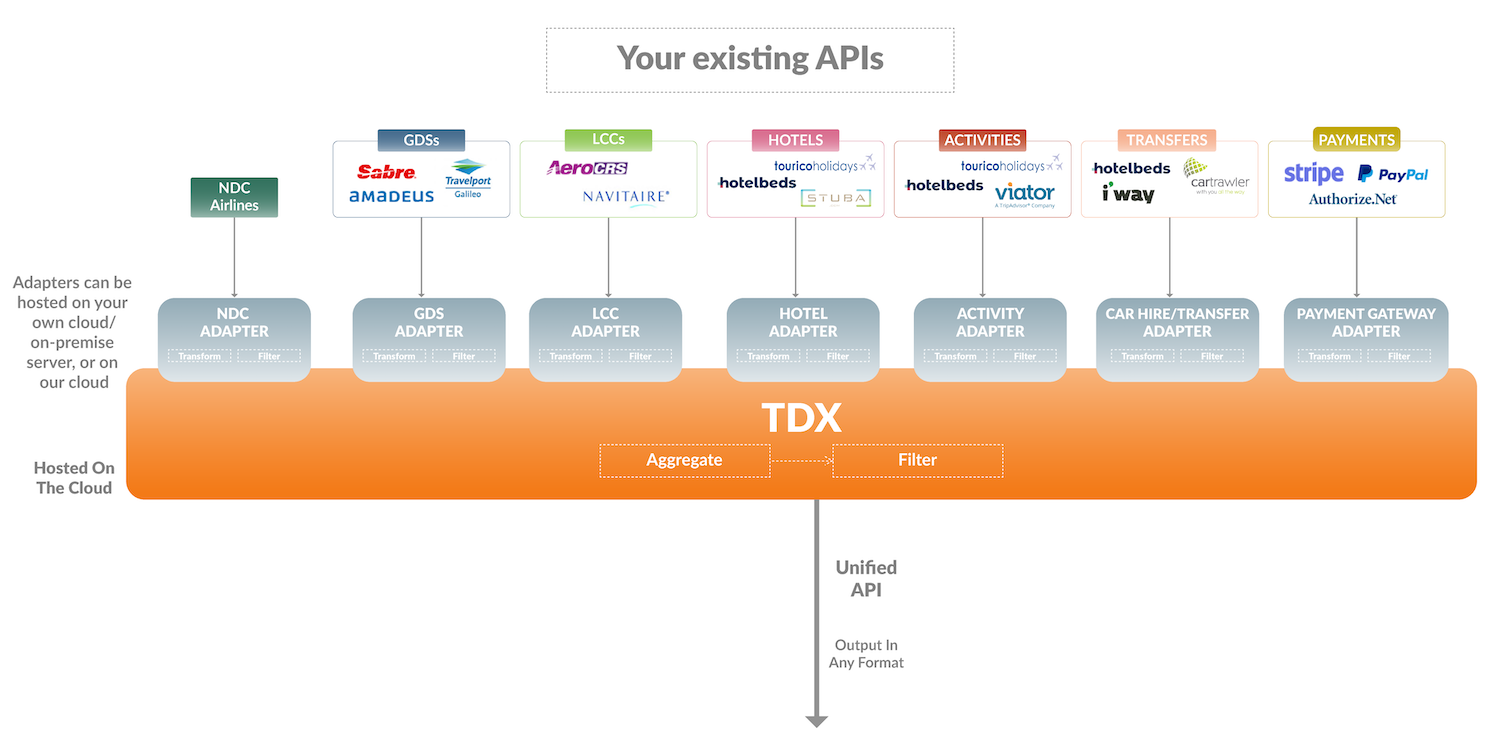
TDX includes pre-built connectors for over 80 global suppliers and 130+ low-cost carriers. For proprietary or custom suppliers not in our ecosystem, your team can extend TDX with our SDK or we can architect custom connectors as part of your implementation. Suppliers require commercial API agreements for activation.
TDX Capabilities
Multi-Supplier Aggregation & Real-Time Orchestration
TDX aggregates content from multiple sources—flights, hotels, sightseeing, car rentals, transfers, rail, bus, and custom products—into a single operational interface. A unified API enables your application to retrieve real-time feeds from all active suppliers in a single request, normalized to your schema. TDX also manages payment gateway orchestration, allowing you to evolve payment providers without refactoring your booking logic.

Custom Integration & SDK-Based Extensibility
TDX provides SDKs and adapter frameworks enabling your engineering team to build and maintain custom connectors for proprietary or specialized suppliers. This approach reduces vendor lock-in, gives you operational control over your supply chain integrations, and accelerates time to integration for non-standard sources.
Streamlined Integration & Operational Efficiency
Building and maintaining individual supplier integrations compounds over time—each supplier schema change, API upgrade, or feed issue requires separate code changes. TDX decouples your application from supplier interfaces through normalization and schema mapping, reducing the operational burden of supplier relationship management and freeing your team to focus on business logic rather than integration maintenance.


Faster Supplier Onboarding & Operational Control
Rather than building supplier-specific integrations individually, TDX enables you to activate new suppliers within days. Once a supplier connector is available in TDX, activating their feeds into your distribution requires a single unified API call, not reimplementation of your booking logic. This accelerates your ability to respond to market opportunities and supplier partnerships.
Channel Distribution & Partner Management
TDX enables you to distribute aggregated supplier content to B2B partners—resellers, sub-agencies, and distribution partners—through a unified API. Built-in channel management, pricing rules engines, and revenue controls let you manage margins, commissions, and business terms per channel. Partners connect once; your TDX instance handles all supplier normalization and orchestration, reducing their integration complexity and your operational overhead.
Schema Normalization & Legacy System Integration
TDX normalizes supplier data into formats compatible with your existing booking engine, CMS, or legacy systems without code changes. The platform transforms multi-format supplier schemas—XML, JSON, custom—into a unified output schema matching your application's data contracts. This enables you to integrate new suppliers, evolve your technology stack, or decouple from legacy systems incrementally, without wholesale platform replacement.
Enterprise-Scale Performance & Operational Monitoring
TDX is architected for high-volume supplier orchestration with elastic scaling—automatically adjusting resources based on traffic patterns and supplier load. Hosted on AWS with multi-region deployment options, TDX maintains performance during peak travel periods while optimizing costs during off-peak hours. Built-in traffic analytics, feed monitoring, and anomaly detection provide operational visibility into supplier health, data quality, and integration performance. On-premise and private cloud deployments are available for regulated or compliance-sensitive operations.

Intelligent Hotel Inventory Mapping & Deduplication
Multi-supplier hotel inventory creates deduplication challenges—the same property represented differently across suppliers confuses booking engines and damages user experience. TDX includes intelligent mapping and deduplication, identifying and consolidating redundant inventory across sources, normalizing property data, and providing a unified view of available properties to your booking and distribution layers.
Feed Orchestration & Operational Controls
TDX provides fine-grained operational controls over supplier feeds and content distribution. Dynamically enable/disable feeds based on business rules—supplier balance thresholds, seasonal availability, route-specific sourcing, or pricing strategies. Intelligent feed orchestration routes searches to optimal suppliers based on destination, customer segment, or product type, minimizing operational costs while maintaining service quality. Revenue management controls let you apply dynamic pricing, margin rules, and channel-specific terms without rebuilding your booking logic.


Global Client Base
Africa : Benin, Cameroon, Kenya, Namibia, Nigeria, Libya, Zambia, Tunisia | Asia : China, Hong Kong, India, Indonesia, Pakistan, Philippines, Thailand, Vietnam | Europe : Albania, Croatia, Greece, Greenland, Italy, Spain, Turkey, United Kingdom | Latin America : Argentina, Chile, Dominican Republic, Honduras, Venezuela | Middle East : Bahrain, Iran, Jordan, Kuwait, Lebanon, Oman, Palestinian Territory, United Arab Emirates | North America : Barbados, Bermuda, Canada, Jamaica, USA, Trinidad | Oceania : Australia, New Zealand